
Indian benchmark indices, Sensex and Nifty, closed lower, primarily due to a downturn in banking and financial stocks, coupled with crude oil prices remaining above USD 80 per barrel. Geopolitical uncertainties and new regulatory proposals for the non-bank lending sector also contributed to cautious investor sentiment.

Indian benchmark indices Sensex and Nifty ended flat on Tuesday, with the Sensex dipping nearly 70 points, as investor sentiment turned cautious ahead of crucial global central bank policy meetings and a significant sell-off in Asian markets.

Indian benchmark equity indices closed higher on Thursday, with the Sensex gaining 273.55 points to 77,928.15 and the Nifty rising 66.95 points to 24,317.15, driven by bargain hunting and short-covering in IT and auto sectors.

Indian benchmark indices, Sensex and Nifty, closed sharply higher, with the Sensex climbing 1,695.40 points and the Nifty surging nearly 2 per cent, driven by a global market rally and a decline in crude oil prices following US President Donald Trump's declaration that his country has ended the war with Iran.


Indian stock markets extended their gains for a third consecutive day, with the Sensex climbing 753 points and the Nifty closing above 24,550, driven by a drop in crude oil prices and optimism surrounding potential peace talks between Iran and the US.

Indian equity benchmark indices Sensex and Nifty tumbled over 1 per cent for the third consecutive day, driven by a sharp rally in crude oil prices, massive selling in IT stocks, and unabated foreign fund outflows amid ongoing geopolitical tensions in the Middle East.
Indian benchmark indices, Sensex and Nifty, saw a significant rebound in early trade, driven by a decline in crude oil prices. This drop followed US President Donald Trump's announcement of progress in negotiations with Iran towards an agreement to end the war, leading to a temporary pause in 'Project Freedom' to escort ships through the Strait of Hormuz. Track Nifty 50 and BSE Sensex performance and key global triggers.

Indian benchmark indices Sensex and Nifty experienced a sharp decline in early trading due to escalating tensions in the Middle East, driving crude oil prices higher. Global market bearishness and foreign fund outflows further contributed to investor unease.

Indian benchmark equity indices, Sensex and Nifty, surged over 1 per cent, driven by a significant correction in crude oil prices and a global market rally, fueled by improving sentiment surrounding potential US-Iran negotiations.
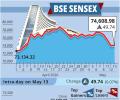
Indian benchmark equity indices, Sensex and Nifty, closed marginally higher, breaking a four-day losing streak, despite elevated crude oil prices and ongoing geopolitical uncertainties. The market saw a temporary pause in panic selling, though cautious sentiment persists.

India now ranks among the world's top three destinations for both AI and STEM talent, holding roughly a 6 per cent share of globally mobile AI talent and a 7 per cent share of STEM talent.

The production-linked incentive (PLI) scheme for the automobile sector has created market distortions, excluded innovation-led electric two-wheeler (e2w) makers, and failed to convert cost advantages into export competitiveness, with 77 per cent of export volumes driven by non-PLI models, said a report released by the Centre for Domestic Economy Policy Research (C-DEP) on Friday.

India's first trillion-dollar company will be built on technology it owns, not just operates, predicts Ajay Kumar.

A BofA Global Research report indicates that Paytm is leading in monetisation compared to its competitors due to its diversified mix of merchant lending and financial services, which enhances profitability and strengthens its position in the Indian fintech market.

'Even if the war ends tomorrow, which is unlikely, and we go back to the pre-war status quo, the world will still need some time to get over the sudden shock of oil price increases.'

There are enough people at the top decision-making level in Tehran who are still willing to negotiate, provided Trump can create the right setting for the negotiation to acquire a dynamic of its own, points out Ambassador M K Bhadrakumar.

At the heart of this debate is Section 3(d) of the Patents Act, a safeguard designed to prevent drugmakers from extending monopoly protection through trivial modifications to existing medicines.

European Commission President Ursula von der Leyen says India and the EU are close to a 'historic trade agreement' that could create a market of two billion people and account for almost a quarter of the global GDP.

The turning point came with the appointment of Sergio Gor as the US ambassador to India.

India should resist knee-jerk responses to tariff volatility in the US and instead use the current geopolitical churn to build manufacturing scale at home, former G20 Sherpa and former chief executive officer of NITI Aayog Amitabh Kant said on Wednesday.

India's electric passenger vehicle (ePV) market has expanded sharply over the past five years, with registrations rising from just 3,252 units in 2020 to about 170,000 in 2025. Throughout this scale-up, southern states have remained the bedrock of adoption, consistently contributing around one-third of national electric vehicle (EV) registrations - emphasising the region's role as the structural backbone of India's EV transition.

India's leading real estate developers are accelerating their push into plotted development, a segment once dominated by unorganised players but now reshaped by branded offerings, faster cash flows and evolving buyer preferences. This strategic shift is visible across markets such as Bengaluru, Chennai, Hyderabad, Gurugram, peripheries of the Mumbai Metropolitan Region (MMR) and even Tier-II cities.

'As more patients are prescribed these drugs, intolerance due to gastrointestinal and other side effects will become more visible, leading to higher discontinuation rates.'

The semaglutide patent expiry next year could unleash a wave of generic versions from Indian drugmakers, with prices expected to go lower -- at least 80 per cent.

Qualcomm is partnering with Indian firms like Lenskart to make smart glasses nearly as affordable as regular eyewear.

Success in this space demands more than luck, it requires sharp analysis, disciplined execution, and understanding market movers.

This Delhi Crime series belongs to Huma Qureshi, who plays Badi Didi as a hateful woman. She also commands some admiration for the way she negotiates with venal men and even some degree of sympathy for making the best of whatever life throws at her, observes Deepa Gahlot.

Sentiment in the market will also be guided by other major market movers like trend in the rupee, Brent crude and foreign capital flows.
Among the Sensex firms, Bharti Airtel, NTPC, Tech Mahindra, Mahindra & Mahindra, Tata Steel, UltraTech Cement, Titan, Axis Bank, JSW Steel and Larsen & Toubro were the major gainers. IndusInd Bank, Kotak Mahindra Bank, HDFC Bank and State Bank of India were the laggards.

The multi-agency search operation to trace 33 missing persons in cloudburst-hit Kishtwar district in Jammu and Kashmir has entered its eighth day. The death toll stands at 65, and rescue efforts are ongoing with the help of multiple agencies and heavy machinery.

As battery prices drop, early customers of Tata Motors, which was the first mover in the passenger EV market, could feel let down.
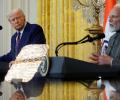
The deal fell through over unresolved disagreements over contentious issues, mainly on agriculture and automotive sector tariffs.

India's hospitality sector is rolling out the red carpet for investors. A flurry of upcoming IPOs, or initial public offerings, the entry of new players, and ambitious expansion plans by Indian and global hotel brands are ushering in what could be the industry's most formalised era yet. Leading the charge are real estate titans, who are turning their hotel arms into global hospitality chains.

At its current stock price, RIL now has 8.4 per cent weight in the Sensex against Infosys' 8.8 per cent.

'Focus on 19,400/64,900 as the key resistance levels for the Nifty/Sensex.'

Boosted by a rally in stocks, total market valuation of listed companies at the National Stock Exchange hit the Rs 100 lakh crore-mark on Wednesday.

Why is Shailesh Chandra, managing director of Tata Motors Passenger Vehicles and Tata Passenger Electric Mobility, not worried about the competition?

In India, fast-moving consumer goods (FMCG) majors continue to hold sway, with incumbent brands cornering 65 per cent of the market share, shows a Bain & Company report. While identifying the continued preference of Indians for incumbent brands, the report says that the dominance of general trade in the country has allowed national brands to maintain their supremacy. The low penetration of e-commerce in the country has also helped large brands.
